
PII Redaction Is a Lifecycle, Not a One-Time Fix
Most teams treat PII redaction as a project. There is a dataset, a deadline, and a definition of done: run the data through a redaction tool, ship the cleaned copy, close the ticket. It feels finished.
It is not finished. Data keeps arriving. New systems come online, new fields show up in a schema, a vendor starts sending a document type nobody planned for, and a model that was accurate last quarter drifts against this quarter’s text. The redaction you did once describes the data as it was on the day you did it, not the data flowing through your systems today.
Privacy is not a one-time fix. It is a lifecycle that turns continuously, and each turn feeds the next.
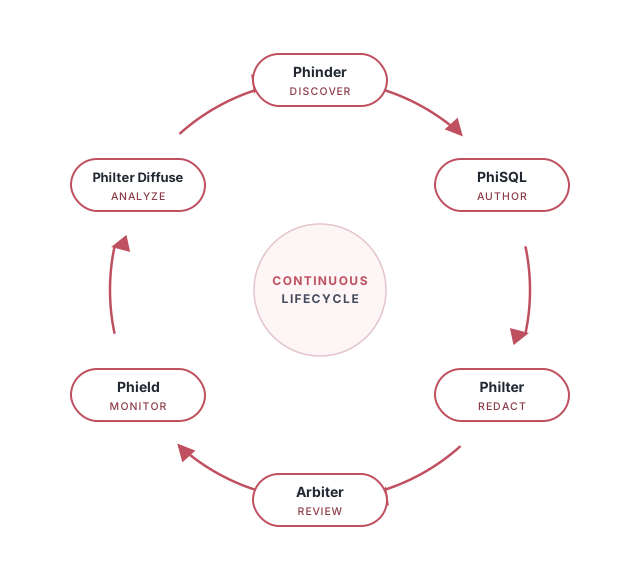
The loop, one stage at a time
The Philterd toolkit is built around this loop rather than around a single redaction step. Each stage has a job, and each hands off to the one after it.
Discover. You cannot protect what you have not found. Phinder crawls your files and directories and maps where sensitive data actually lives, so the work starts from evidence instead of assumptions. A scan can even emit a starter policy that enables the entity types it found.
Author. Redaction rules should be readable and version-controlled, not buried in a console. PhiSQL and the Redaction Policy Editor both produce the same Phileas policy: one in text, one visually. The policy says which entity types to act on and how to handle each.
Redact. Philter, and the Phileas library underneath it, apply the policy to your text. This is the stage most people think of as “redaction,” but on its own it is only a sixth of the story.
Review. Automated detection is probabilistic, not perfect. Arbiter puts a human in the loop to accept, override, and code the spans the detector found, and every decision is recorded in the audit trail.
Monitor. Once redaction is running in production, Phield watches the PII type counts flowing through your pipelines and alerts when one breaks from its trend. A sudden spike in credit-card numbers, or an unexpected drop in redacted names, is a signal that something upstream changed.
Analyze. Even the counts you keep for oversight can leak information about individuals. Philter Diffuse applies differential privacy to those aggregates so you can report on them without exposing anyone.
Then the loop closes. What monitoring surfaces and what analysis reveals become the inputs to the next discovery pass, and the cycle turns again.
Why it has to be a cycle
Each stage exists because the stage before it is never final.
- Data drifts. New sources, new formats, and new entity types appear constantly. A one-time scan goes stale the moment the next batch lands.
- Policies drift. A rule that made sense for last year’s data can quietly over-redact or under-redact this year’s. Because the policy is a versioned artifact, you can diff it, test it, and roll it forward.
- Models change. Detection accuracy depends on how closely your text resembles what a model has seen. Measuring and reviewing on real output is how you catch a regression before it reaches production, not after.
- Oversight creates new data. The audit trails, counts, and reviewed decisions the loop produces are themselves sensitive, and they feed back into discovery and analysis.
Treating any one of these as “done” is how sensitive data slips through months after the original project shipped.
One policy holds it together
The reason the loop works as a system, and not as six disconnected tools, is that every stage speaks the same Phileas policy format. You define your redaction rules once. Discovery suggests them, the editor and PhiSQL author them, Philter and Phileas enforce them, Philter Scope measures them, and the AI Proxy applies them to LLM traffic. There is no drift between what you intended and what each tool actually does, because there is only one definition.
And all of it runs inside your own perimeter. Discovery, redaction, review, and monitoring happen on your infrastructure, so the data you are trying to protect never has to leave it to be protected. You can see how the pieces connect on the architecture page.
Start anywhere, but keep turning
You do not have to adopt the whole lifecycle at once. Most teams start where the pain is: a discovery scan to see the scope of the problem, or a redaction API in front of a single pipeline. The point is not to run every stage on day one. The point is to stop thinking of redaction as a task you finish and start thinking of it as a loop you maintain.
Redaction is configurable and probabilistic. It reduces how much sensitive data gets through; it does not catch every instance on its own, and you are responsible for validating output against your own data. That is exactly why the lifecycle matters: the review, measurement, and monitoring stages are what turn a single redaction step into a privacy posture you can trust over time.
Browse the open source toolkit, or get in touch if you want help standing up the loop in your own environment.